Pulmonary Research is where Pneuma Health Journal gathers the latest thinking on lung science, from basic mechanisms to clinical implications. We cover a wide arc of topics that matter to readers who want clear, accessible context without sacrificing depth. Expect coverage of cellular and molecular insights, imaging advances, and how new tools translate into understanding real-world lung health. We also compare how different approaches in monitoring, treatment, and public health intersect to affect patients and populations.
Key topic clusters include small airway disease and remodeling, genetic and genomic approaches to lung conditions, remote and home-based monitoring of chronic lung disease, advances in imaging and functional metrics, biomarker discovery in interstitial lung disease, and the links between sleep-disordered breathing and chronic lung disease. We also analyze the evolving landscape of air quality research, indoor environments, and how policy and technology shape respiratory health outcomes.
Our aim is editorially accessible translation of peer-reviewed sources, not medical advice. Readers will find concise explanations of complex topics, critical evaluation of emerging data, and practical context for clinicians, researchers, and informed lay readers. The section sits alongside Air Quality, Public Health & Lungs, and Respiratory Health, offering complementary angles while maintaining its own focus on pulmonary science and its real-world implications.
What you’ll see here
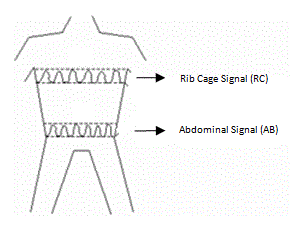
Respiratory inductance plethysmography (Autor: Vivonoetics · Licencia: Public domain · Fuente: Wikimedia Commons)
Articles in this category explore the mechanisms of lung disease, diagnostic and therapeutic innovations, and the people behind the data. Expect pieces that unpack the potential of CRISPR and gene editing for lung conditions, the role of biomarkers in interstitial lung disease, and the promises and limits of remote monitoring for COPD. We break down how imaging advances—from CT to functional metrics—alter clinical understanding, and how airway remodeling features influence management in asthma.
In keeping with our mission to translate peer-reviewed work into accessible reads, we show how researchers frame questions, how study designs influence conclusions, and what clinicians might practically take away when considering new evidence. Each piece aims to clarify what is known, what remains uncertain, and what future directions appear most promising.
Geographic and practical context
While our audience is global, we report in USD pricing references for tools and services commonly encountered by readers in the United States and international settings. We compare resources and platforms used by researchers and clinicians around the world, including widely recognized providers like NordVPN and ExpressVPN as neutral reference points for data privacy in research workflows. We reference widely available standards, such as the use of cloud-based analytics, remote patient monitoring, and imaging modalities that are adopted across healthcare systems.
Below is a practical snapshot of how the category interacts with real-world environments in 2025. The table highlights representative services, typical price ranges, and common capabilities that readers may encounter when translating research into practice or policy.
Service / Tool
Typical Starting Price (USD)
Key Features
Notes for Researchers
Remote Monitoring Platforms
$15–$60 per patient per month
SpO2 tracking, activity data, symptom logging
Useful for COPD and sleep-disordered breathing studies; cost varies by scale
Imaging Software (CT/QSM)
$0–$3000 upfront per license
Quantitative metrics, volumetry, airway analysis
Adopted in research and some clinical environments; licensing varies
Genomic Testing Services
$100–$900 per test
Variant calling, gene expression panels
Used in studies of genetic risk for lung disease; data interpretation requires expertise
Country-specific context you may notice
Respiratory therapist (Autor: ISAF Headquarters Public Affairs Office from Kabul, Afghanistan · Licencia: CC BY 2.0 · Fuente: Wikimedia Commons)
In the United States, most hospitals and universities rely on IRB approval for pulmonary research, with oversight from bodies like the FDA for device-related studies and the NIH for funding. Data privacy considerations frequently reference HIPAA compliance and secure cloud environments. In Europe, researchers navigate GDPR requirements and may face different funding cycles and ethics review processes, influencing study design and reporting timelines. In parallel, researchers worldwide increasingly share data through open repositories and preprint servers while maintaining peer-reviewed publication standards.
For readers following market developments, expect pricing and access patterns to reflect local health systems. In the U.S., privée health plans and hospital networks may negotiate data access and bioinformatics service bundles differently than public or university-based research programs in other regions. When evaluating new tools, consider both upfront costs and long-term maintenance, including software updates, security allocations, and user training.
Why this matters
Pulmonary science intersects with daily life through air quality, indoor environments, and sleep health. Understanding the mechanisms behind small airway disease, remodeling, and biomarker discovery helps readers critically assess new studies and policy proposals that aim to improve lung health outcomes. We spotlight how emerging techniques can change screening, diagnosis, and treatment, while remaining mindful of limitations and the need for robust, context-aware interpretation.
People first guides, such as sleep-disordered breathing links or COPD remote monitoring feasibility, connect bench research to patient experience and clinical practice. We emphasize transparency about what is known, what isn’t, and how tomorrow’s discoveries may translate into better respiratory health for diverse populations.
Next steps for readers
Explore the posts highlighted above to see the spectrum of topics our Pulmonary Research section covers. As the field evolves, we will continue to contextualize breakthroughs, compare approaches, and translate complex findings into clear, reader-friendly narratives without sacrificing scientific integrity.
Small airway disease (SAD) has emerged from the shadows of obstructive lung disease as a centerpiece for understanding airway biology, heterogeneity in sym…
CRISPR and gene editing are moving from laboratory curiosities to potential tools for understanding and, eventually, treating lung diseases. This piece exa…
This editorial evaluates how remote monitoring for chronic obstructive pulmonary disease (COPD) is shaping our understanding of disease progression through…